
Inside the hospital: Care, Departments, and Services
Four ways hospitals classify care
Hospital staff classify care in four ways at once: by level (how specialized it is), by purpose (what it is for), by urgency (how soon it is needed), and by stay (how long the patient remains in the building). Conversations mix these freely, so all four vocabularies are needed to follow them.
Levels of care: primary, secondary, tertiary, quaternary
Primary care is the first point of contact for common illness and routine care, delivered by GP clinics, family doctors, and primary health centres (PHCs); examples include fever, infections, blood pressure checks, and vaccinations. Secondary care is specialist care, usually on referral, delivered at district hospitals, nursing homes, and mid-size hospitals; examples include general surgery, normal and C-section deliveries, and fracture care. Tertiary care is advanced super-specialty care at large corporate and teaching hospitals, such as cardiac surgery, neurosurgery, oncology, and transplants. Quaternary care extends tertiary care to rare, highly specialized, or experimental treatment at a small number of centres of excellence.
These levels form the referral ladder: a GP refers a patient to a nursing home, which refers onward to a super-specialty hospital. In India’s public system the same ladder runs from sub-centre to PHC, community health centre (CHC), district hospital, and finally medical college hospital.
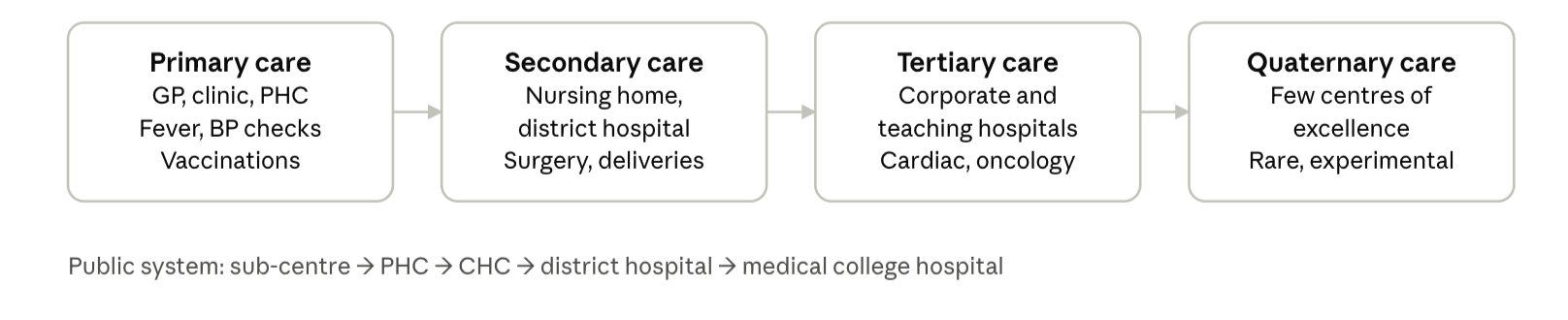
Care becomes more specialized, and usually more expensive, at each step up the ladder.
Preventive care and its three layers
Preventive care aims to stop illness before it starts or catch it early. Primary prevention stops disease from occurring, through vaccination and health education. Secondary prevention detects disease early through screening such as mammography, blood sugar and cholesterol checks, and cancer screening. Tertiary prevention keeps an existing condition from worsening, for example managing diabetes to prevent kidney or eye damage. Commercially, preventive care covers health-checkup packages and corporate wellness contracts, which are planned, predictable, and often a patient’s first visit to a hospital.
Diagnostic, curative, and rehabilitative care
Diagnostic care finds out what is wrong through lab tests, imaging, and biopsies. Curative or therapeutic care treats the condition with medication, a procedure, or surgery. Rehabilitative care restores function after illness, injury, or surgery through physiotherapy, occupational therapy, and speech therapy.
Chronic care management
Chronic care management is long-term, ongoing care for conditions that do not go away, such as diabetes, hypertension, kidney disease and dialysis, and asthma. Because it is recurring rather than one-off, it is the most relationship-heavy kind of care.
Palliative care
Palliative care is comfort-focused care for serious or end-stage illness that aims at quality of life, pain and symptom relief, and family support rather than cure. It is often mistaken for end-of-life care alone, but it can run alongside active treatment.
Care by urgency: emergency, urgent, elective, cosmetic
Emergency care is for life- or limb-threatening conditions such as heart attack, stroke, or major trauma, and is given immediately without scheduling. Urgent care needs attention within hours or days, as with appendicitis or a fracture needing fixation. Elective care is planned in advance for a real condition whose timing is flexible, such as knee replacement, cataract surgery, hernia repair, or a planned C-section. Cosmetic or aesthetic procedures, such as rhinoplasty for appearance, hair transplants, or liposuction, are chosen purely for appearance rather than medical need.
Elective does not mean optional or cosmetic
“Elective” is the most misunderstood word in hospital vocabulary: it means a procedure can be scheduled, not that it is optional or unimportant. An elective knee replacement treats a genuine medical problem that simply does not have to happen today. Elective procedures are also different from cosmetic ones: elective procedures are medically needed and usually covered by insurance, while purely cosmetic procedures generally are not, which changes who pays and how price-sensitive the patient is.
Care by stay: OPD, day care, IPD, ICU
Outpatient (OPD) care sees patients in and out on the same day without an overnight stay. Day care covers procedures under anaesthesia with discharge the same day, within 24 hours, such as cataract surgery, dialysis, chemotherapy sessions, endoscopies, and minor surgery; insurers cover a defined list of day-care procedures that varies by insurer. Inpatient (IPD) care admits the patient to a bed overnight or longer, and ICU or critical care serves the sickest inpatients with continuous monitoring. Day care is valued by hospitals and clinics because it is high-turnover and operationally efficient.
Planned versus unplanned admissions
A planned admission, such as elective surgery or scheduled treatment, can be predicted and prepared for. An unplanned admission comes through the Emergency department and cannot be predicted.
How each type of care behaves as a business
Each type of care creates different business behavior and patient-communication needs. Preventive checkups are planned, packaged, often corporate-sponsored first touchpoints, needing booking reminders, fasting instructions, report delivery, and annual re-booking. Elective surgery is predictable and high-value, scheduled weeks ahead, where no-shows and late cancellations are costly; it needs pre-op instructions, document checklists, reminders, and payment and pre-authorization updates.
Emergency care has unpredictable volume, high acuity, and stressed families, so it needs family updates, clear billing, and discharge instructions. Day care is high-turnover with many touchpoints in a few hours, needing arrival and preparation reminders, post-procedure instructions, and next-day follow-up. Chronic care brings recurring revenue and long relationships, needing medication-adherence messages, scheduled follow-ups, and periodic test reminders. Being able to say, for example, that an elective, planned-admission business faces a high cost per no-show is a sign of speaking the hospital’s language.
OPD: the outpatient department
The Outpatient Department (OPD) is the front door for patients who are not admitted. Patients register, wait, increasingly through a token or queue system, consult a doctor, receive a prescription and possibly lab or radiology orders, and leave the same day. OPD volume is a hospital’s best early signal of brand strength, because it is where patients first choose one hospital over a competitor.
IPD: the inpatient department
The Inpatient Department (IPD) holds admitted patients in wards, which may be general, semi-private, private, or suites, tracked through Admission-Discharge-Transfer (ADT) workflows. IPD carries the heaviest nursing load, with vitals charting, medication rounds, and doctor rounds several times a day. Discharge planning, which ensures a patient leaves with the right instructions, medicines, and follow-up booked, is where much readmission risk and patient dissatisfaction is either managed or missed.
OP operations: a flow problem
Outpatient operations are a flow problem: moving a high volume of patients through short visits of minutes to an hour as smoothly as possible. The main challenges are scheduling doctors across OPD sessions, often split into morning and evening, managing queues and tokens, and keeping waiting times short. Key metrics are patients seen per doctor per day, average wait time, OPD-to-admission conversion, and no-show rate. Revenue per patient is low and made up by volume, staffing is heavy at the front desk and registration, and long waits damage patient experience immediately.
IP operations: a capacity-allocation problem
Inpatient operations are a capacity-allocation problem: far fewer patients, but each occupies a scarce bed for days and needs coordinated input from nursing, pharmacy, diagnostics, dietary, and sometimes the OT. Key metrics are occupancy rate, average length of stay (ALOS), bed turnover ratio, and average revenue per occupied bed (ARPOB), because an unnecessarily occupied bed is both a cost and a blocked admission. Revenue per patient is much higher, but so is complexity.
A common inpatient problem is bed-blocking, where a patient is medically ready to leave but stays an extra day or two because billing, insurance paperwork, or the discharge summary is not ready.
Why OP and IP operations are managed separately
An outpatient operations manager is judged on speed and throughput, while an inpatient operations manager is judged on resource use and avoiding wasted bed-days. Larger hospitals and chains often have separate OP and IP Operations Managers, while at smaller hospitals one Operations Manager or the Administrator handles both. A pitch about “operational efficiency” should specify which side it means: on the OP side it means cutting wait times and no-shows, and on the IP side it means reducing bed-blocking and speeding the cycle from discharge to the next admission.
Emergency and casualty
The Emergency or Casualty department runs 24 hours a day and works on triage, sorting patients by severity, commonly with a red, yellow, and green system, so the sickest are seen first regardless of arrival order. It coordinates closely with ambulance services and is usually the most protocol-driven department, because decisions are made in minutes.
ICU and critical care
The ICU provides continuous monitoring for the sickest patients and is divided into specialized units: general ICU, NICU for newborns, PICU for children, and CCU for cardiac patients. Nurse-to-patient ratios are much tighter than on general wards, and a hospital’s clinical reputation is made or lost here in real time.
Operation theatre (OT)
The Operation Theatre (OT) handles surgery from pre-operative preparation through anaesthesia, the procedure, and post-operative recovery. OT scheduling is a hard optimization problem because theatres and idle time are both expensive. Every OT depends on the Central Sterile Supply Department (CSSD) to sterilize instruments between cases.
Obstetrics and gynaecology
Obstetrics and Gynaecology runs its own labour room and delivery suite, often semi-independently from general IPD. This is because deliveries need specialized monitoring, such as fetal heart rate and labour progress, and arrive at unpredictable times.
Nursing services
Nursing services are not a single department but the connective tissue across every ward, OT, and ICU. Nurses are a patient’s most frequent point of contact with the hospital, which makes them a large and under-used channel for patient communication.
Physiotherapy, rehabilitation, dietary, and nutrition
Physiotherapy and rehabilitation, and dietary and nutrition services, are smaller but steady departments that support recovery. Physiotherapy covers post-surgical and post-injury rehabilitation, while clinical nutrition plans diets for inpatients with specific needs, such as diabetic, renal, or post-bariatric patients.
Laboratory and pathology
A hospital laboratory, or pathology department, is divided into biochemistry, microbiology, haematology, and histopathology. Its work runs on sample accessioning, processing, quality control, and report delivery. Turnaround time (TAT), the time from sample to report, is the metric labs are judged on by both the hospital and patients.
Radiology and imaging
Radiology covers X-ray, ultrasound, CT, MRI, and mammography, each with its own scheduling and equipment. A radiologist reads the images and sends a report back to the treating doctor. This workflow depends entirely on RIS/PACS software, which schedules studies and stores and shares the images.
Pharmacy
A hospital pharmacy has an inpatient side, which dispenses unit doses tied to the nursing medication round, and an outpatient side, which dispenses walk-up orders against prescriptions. The pharmacy also manages drug inventory and narcotics control, and increasingly monitors adverse drug reactions (ADRs).
Blood bank
The blood bank manages donors, blood grouping and cross-matching, separation of blood into components, and storage. It is tightly regulated and has its own compliance regime, separate from the rest of the hospital.
Central Sterile Supply Department (CSSD)
The Central Sterile Supply Department (CSSD) sterilizes every reusable surgical instrument used in operation theatres and procedure wards. Patients never see it, but every department downstream depends on it.
Biomedical engineering
Biomedical engineering maintains and calibrates all clinical equipment, including ventilators, monitors, and imaging machines. It is usually noticed only when something breaks.
Front office, medical records, and billing
The front office, or registration desk, is a patient’s first point of contact; it captures patient demographics and books appointments. The Medical Records Department (MRD) stores and retrieves patient charts, handles ICD diagnosis coding, and is the department NABH and government audits rely on most. The billing and insurance/TPA desk processes cash, insurance, and government-scheme (PM-JAY) bills, and cashless claims through TPAs are a major source of both revenue and friction.
Finance, HR, and IT
Finance and Accounts owns the hospital’s profit and loss and is the final checkpoint for any software purchase above a set threshold. HR and Payroll manage staffing, rostering, and compliance for a workforce that often runs three shifts a day, every day of the year. The IT department owns infrastructure, security, and integration feasibility; if IT says a product cannot connect to the hospital’s HIMS, the deal stalls regardless of anyone else’s support.
Facilities, marketing, and quality functions
Housekeeping, security, and procurement or stores are facilities functions that rarely drive software purchases but matter for physical deployments such as kiosks and displays. Marketing and Patient Relations (PRO) own the hospital’s brand, patient feedback, and increasingly the budget for digital patient engagement, which makes them a common internal champion for patient-communication products. The Quality and Accreditation Cell owns NABH (hospital) and NABL (lab) accreditation, including patient-feedback and grievance-redressal measures that a communication platform can help meet.
Referral networks and why they matter
Most patients at mid-size and large hospitals arrive by referral rather than walking in. General practitioners, small nursing homes, standalone clinics, and specialists without the right infrastructure, such as an OT, ICU, or advanced imaging, send complex cases onward. Managing this referral pipeline is a distinct function, usually within Marketing/PRO or, at larger hospitals, a Business Development or GP Relations team, and it drives a large share of patient volume separate from walk-in OPD traffic.
Legitimate ways hospitals build referral relationships
GP liaison or referral relationship officers build and maintain relationships with GPs, clinics, and nursing homes in the hospital’s catchment area so their hospital is the first call for complex cases. Hospitals also sponsor Continuing Medical Education (CME) talks and events for referring doctors, which is permitted, common, and builds both clinical credibility and goodwill. Referral-tracking software records which doctor referred which patient and reports back to the referring doctor on the outcome, and this feedback loop is what keeps referrals coming.
Empanelment programmes create a formal network of referring doctors and clinics, sometimes with professional courtesies such as priority appointment slots, fast-tracked diagnostics, or direct access to the hospital’s specialists for case discussion. Health camps and community outreach, run with local GPs, serve as both patient outreach and relationship-building with the referral network.
Cut practice and the legal line on referrals
Under India’s medical regulations, specifically the National Medical Commission’s Code of Ethics, which carries forward earlier Medical Council of India rules, a doctor may not receive cash, gifts, or other inducements in return for referring a patient. Paying a referring doctor a percentage or flat fee per referral is known informally as “cut practice.” It is illegal and condemned by medical associations but persists informally in parts of the private sector, especially around diagnostics and elective procedures, and legal and professional risk falls on anyone who facilitates it, not only the doctor who receives it.
The practical rule is to build relationships, not transactions. CME sponsorship, referral tracking, professional courtesies, and reporting outcomes back to referring doctors are legitimate and respected ways to grow referrals, while cash for referrals is not. Treating the two as the same is both a legal risk and a sign of not understanding how legitimate referral work operates.
Referrals and patient communication
When a referred patient arrives, two things decide whether the referral relationship survives: the patient’s own experience, and whether the referring doctor hears about the outcome. A referred patient who disappears into a large hospital with no report back to the GP who sent them breaks the relationship and costs future referrals, not just the current one.