
The Hospital
Three arms in one building
A hospital works as three organizations sharing one building: a clinical arm, a nursing arm, and an administrative arm. The clinical arm treats patients and is led by a Medical Director or Chief of Medical Services, with Heads of Department (HODs) for each specialty, such as cardiology, orthopedics, and oncology, reporting to them. Doctors report clinically through this line.
The nursing arm runs in parallel to the clinical arm rather than underneath it. A Nursing Superintendent oversees ward, operation theatre (OT), and ICU nursing as a separate reporting chain, because nurse staffing, shift rostering, and nursing protocols are managed apart from the doctors nurses work alongside.
The administrative arm runs the hospital as a business. A Hospital Administrator or Chief Operating Officer (COO) owns finance, HR, IT, procurement, housekeeping, the front office, and the Medical Records Department (MRD). All three arms report to a CEO or Medical Superintendent, who answers to a governing body: a trust, a family promoter group, a corporate parent such as Apollo, Fortis, or Max, or, for government hospitals, a state health department.
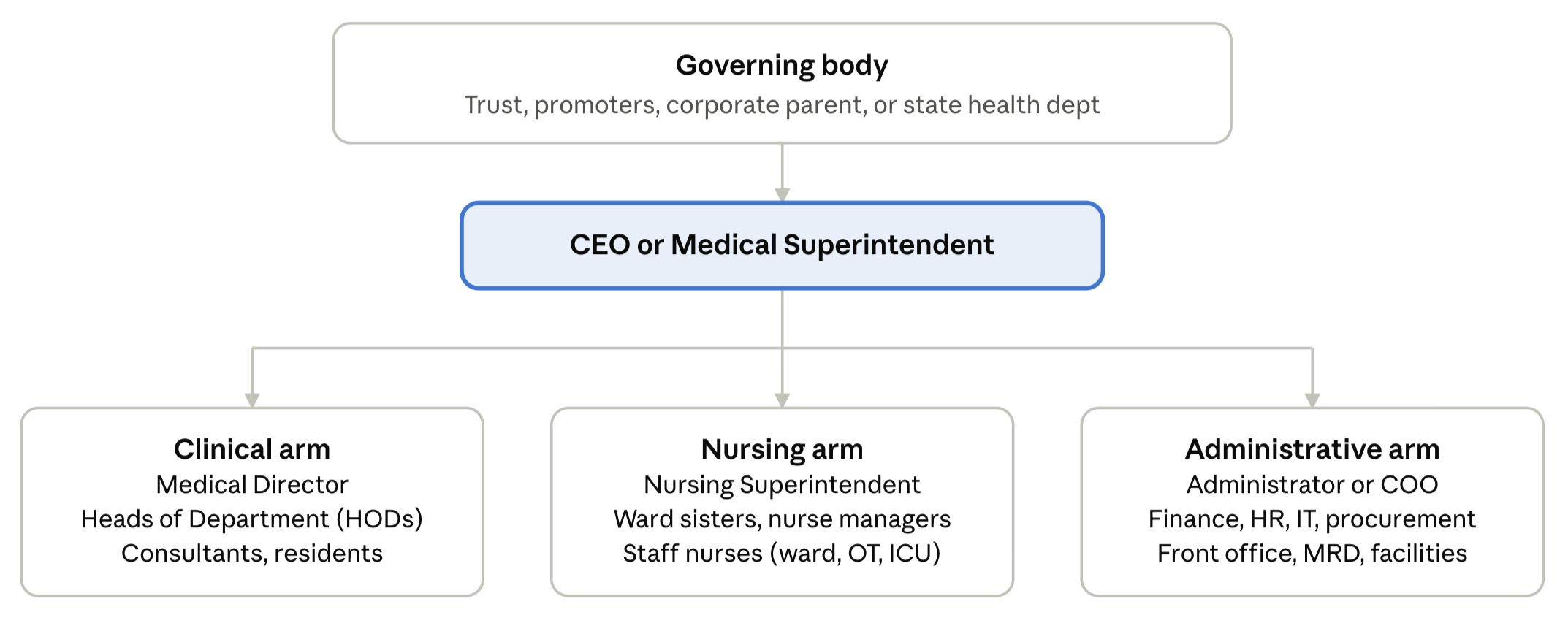
Nursing reports to the hospital head in its own line, beside the clinical arm rather than under it.
Why hospital purchases need several approvals
Almost nothing in a hospital is bought through a single approval, because most products touch more than one arm. A patient-communication platform, for example, affects clinical workflow (the Medical Director’s office), nursing reminders (Nursing), IT infrastructure (the CIO), and the budget (the Administrator and Finance). Selling to a hospital means selling to a structure, and knowing where a product sits across the three arms shows who must agree before a purchase can happen.
The hospital fiscal year and budget timing
Most Indian hospitals follow the national April-to-March fiscal year. Budgets for the coming year are locked in the fourth quarter, January to March. The best time to influence a purchase is therefore usually August to December, during budget planning, rather than in the March rush.
Hospital ownership models
Ownership is the biggest single factor in how long a hospital deal takes and who signs it. Indian hospitals fall into five ownership models: trust or charitable, corporate or chain, single-owner, government, and public-private partnership (PPP). Each runs on different financial logic, so identifying the model before the first call changes how to pitch, whom to ask for, and how long to expect to wait.
Trust and charitable hospitals
Trust or charitable hospitals are registered under a public charitable trust or society; examples include Tata Memorial, CMC Vellore, and most large non-profit teaching hospitals. They are funded by donations, government grants, and cross-subsidy, in which paying patients effectively fund free or discounted beds for poorer patients. Many must provide a quota of free or subsidized treatment in return for land or tax benefits, and most are tax-exempt under Sections 12A and 80G, so spending is checked for compliance and not only for return on investment.
Decisions at trust hospitals are made by a Board of Trustees, often through a formal procurement committee, because trustees have a fiduciary duty to show money was spent responsibly. This makes them slow and consensus-driven but genuinely mission-aligned, so a pitch about patient access and care quality works better than a pure revenue pitch. Sales cycles are long, price sensitivity is high, and a product may end up funded by CSR or grant money rather than the operating budget.
Corporate and chain hospitals
Corporate or chain hospitals are publicly listed or private-equity-backed companies such as Apollo, Fortis, Max, Manipal, Narayana, and Aster. They are funded by shareholders and institutional investors and run with quarterly earnings discipline, with leadership measured on revenue per bed, EBITDA margin, and same-store growth.
Buying decisions at chains are centralized at corporate headquarters, not at individual hospitals. Most chains keep an approved-vendor list, and getting a new product category empanelled across the group is a separate process that usually comes before any single hospital buys. Vendors should expect a formal RFP, a business case with projected ROI, and sign-off from IT, Finance, and often a digital transformation or innovation team. First deals typically take 4 to 9 months, but once empanelled, the same deal can roll out to 20 or more hospitals without re-selling each one.
Single-owner hospitals
A single-owner or proprietorship hospital is a nursing home or standalone hospital owned by one doctor or a small partnership, with no outside shareholders. It is usually funded by the owner’s savings and a bank loan, and earns revenue from cash and insurance billing. The owner, often still a practicing doctor, decides directly, sometimes in the first meeting, so sales cycles take days to weeks. Price sensitivity is the highest of any model because it is the owner’s own money, relationship selling works best, and the decision-maker is often also a daily user of the product.
Government hospitals
Government hospitals are funded by state or central health department budgets and by reimbursements under the PM-JAY scheme. They buy through government channels: listings on the GeM portal, formal tenders, and L1 rules that award contracts to the lowest bidder. They are the slowest model to sell into and leave vendors the least room to compete on anything except price and compliance paperwork.
Public-private partnership (PPP) hospitals
A PPP hospital combines government-provided land, buildings, or infrastructure, sometimes an existing government hospital, with a private operator that runs daily operations and clinical services under a long-term contract, often 20 to 30 years. Day to day, the private operator makes clinical and IT decisions much like a corporate chain, with its own procurement process and ROI expectations. However, capital spending above a threshold, or anything touching the original government contract, can need approval from a government oversight body or joint committee.
The practical risk with PPP hospitals is that a purchase that looks operational can slip into government-style approval timelines if it is structured as a capital expense instead of a subscription. Asking early which side of the contract a purchase falls under is the best predictor of whether it closes in weeks or stalls for months.
Comparing the ownership models
Trust hospitals are funded by donations, grants, and cross-subsidy, decide through trustees or a procurement committee, buy slowly over months, and are highly price-sensitive for mission and compliance reasons. Corporate chains are funded by shareholders, decide at a central HQ committee of IT, Finance, and Digital, take 4 to 9 months for a first deal but scale quickly after, and need an ROI case. Single-owner hospitals are funded by the owner’s capital and bank loans, decide through the owner directly within days or weeks, and are the most price-sensitive. Government hospitals are funded by state or central budgets and PM-JAY, decide through tenders, are the slowest overall, and follow strict lowest-bidder rules. PPP hospitals combine government infrastructure with private operating revenue, are fast for operational purchases but slow when a purchase touches the government contract, and need watching for budget-threshold traps.
Major Indian hospital groups
Apollo Hospitals is India’s largest private hospital chain by scale and also runs pharmacy and diagnostics businesses. Fortis Healthcare is a major multi-city chain within the IHH Healthcare group, Max Healthcare is strongest in North India, especially Delhi NCR, and Manipal Hospitals is a large multi-city chain with roots in medical education. Narayana Health is known for high-volume, lower-cost cardiac care, Aster DM Healthcare is strong in the Gulf and South India, and Medanta, headquartered in Gurgaon, is strong in cardiac and multi-specialty tertiary care.
Kokilaben Dhirubhai Ambani Hospital in Mumbai is a high-profile single flagship hospital within the Reliance Group. Rajiv Gandhi Cancer Institute in Delhi is a leading trust-model cancer institute, and CMC Vellore and Tata Memorial are trust-model institutions with major teaching and research reputations. The other groups listed here follow the corporate chain model.
Diagnostic and pathology chains
Diagnostic and pathology chains such as Dr Lal PathLabs, Metropolis, SRL, and Thyrocare run a hub-and-spoke model, in which many small collection centers feed a central processing lab. Their business depends on turnaround time (TAT) and home-collection logistics rather than bed count. Buying decisions are usually centralized at headquarters with operations and marketing teams, not branch managers, and follow a discipline similar to a corporate hospital chain on a smaller team.
Standalone specialty clinics
Standalone specialty clinics include dental, fertility and IVF, dermatology and aesthetic, eye-care, and dialysis chains; NephroPlus is a well-known dialysis chain. They usually buy like single-owner hospitals, with fast, owner-led decisions, but their revenue models differ by specialty. Dialysis and fertility clinics earn recurring, chronic-care revenue, while dental and aesthetic clinics are elective and cash-heavy, which affects how price-sensitive they are.
Health-tech and telemedicine platforms
Health-tech and telemedicine platforms such as Practo, Pristyn Care, Tata 1mg, PharmEasy, and teleconsultation apps are tech-savvy, API-first buyers. They expect a conversation about integration rather than a feature demo. Many are venture-funded, so internal discussions often focus on customer acquisition cost (CAC) and growth metrics as much as clinical outcomes.
Health insurers and TPAs
Health insurers such as Star Health and ICICI Lombard Health, and Third Party Administrators (TPAs) that process claims for insurers and corporates, are claims-processing businesses rather than care providers. For these customers, the value of a communication product shifts from talking to patients to talking to policyholders about policies and claim status. The product category is the same, but the buyer’s logic is entirely different.
How cashless insurance claims work
In a cashless claim, the patient pays nothing upfront. The hospital gets pre-authorization from the TPA before treatment, bills the TPA directly, and settles after discharge. Pre-authorization delay is the biggest friction point, because treatment can be held up while waiting for TPA approval, which makes it a patient-experience problem and not only an administrative one.
How reimbursement claims work
In a reimbursement claim, the patient pays the hospital upfront and then submits bills to their insurer or TPA to be paid back. This is slower for the patient but simpler for the hospital.
PM-JAY billing versus private insurance
PM-JAY, the government health insurance scheme, reimburses empanelled hospitals directly at fixed government package rates. Private insurance runs through a commercial TPA relationship with rates negotiated in each insurer-hospital contract. The two processes are not interchangeable, and hospital billing teams handle them very differently.
Billing and TPA staff as a stakeholder group
Billing desk staff and TPA coordinators are a stakeholder group distinct from clinical and IT staff. Because they manage pre-authorizations, claims, and payments, they are a natural audience for any product feature involving payment reminders or claim-status communication.
Market size and bed density
IBEF estimates India’s hospital market at US135.3 billion in 2026 and a projected US$202.5 billion by 2030, a compound annual growth rate of about 10.6 percent (IBEF, updated September 2026). Hospitals account for nearly 80 percent of the overall healthcare market. India has about 1.3 hospital beds per 1,000 people, far below the global median, which is why capacity expansion remains a major investment theme.
Recent sector performance
EY-Parthenon reported that major Indian hospital chains grew both revenue and EBITDA by more than 15 percent year on year in FY26, with high-acuity specialties such as cardiology and oncology growing fastest (Tribune India, reporting the EY-Parthenon report). Single-specialty hospital operators also grew revenue by more than 15 percent with EBITDA margins around 30 percent, while medical device makers had a weaker year, partly because of US tariffs.
In Q2 FY26 (July to September 2025), ARPOB across leading hospital networks rose 10 to 16 percent year on year, diagnostics chains grew revenue 10 to 22 percent, and leading chains announced plans to add more than 18,000 beds over three to five years (EY). The EY update of September 2026 reported continued double-digit revenue growth at leading hospital operators in Q1 FY27 (April to June 2026), driven by higher occupancy, a better specialty mix, and more advanced procedures (EY). Private-equity-backed buyouts of hospitals increased in FY26 as investors built regional hospital clusters.
Patient attitudes to certified care
A FICCI and EY-Parthenon report from October 2025 found that 9 in 10 Indians are willing to pay more for certified healthcare, and that transparency drives patient choice (EY). This supports the commercial value of accreditation such as NABH.
National Family Health Survey (NFHS-6)
The National Family Health Survey (NFHS) is India’s largest household survey of population, health, nutrition, and family welfare, run by the Ministry of Health and Family Welfare with the International Institute for Population Sciences (IIPS), Mumbai as nodal agency. NFHS-6 was conducted in 2023-24, released in mid-2026, and covers about 6.79 lakh households across 715 districts; it is the first round since COVID-19 (Drishti IAS).
NFHS-6 shows antenatal care coverage rising from 92.6 to 95.9 percent, mothers with at least four antenatal visits from 58.5 to 65.2 percent, and institutional deliveries from 88.6 to 90.6 percent compared with NFHS-5. About 95.6 percent of children received most of their vaccinations at public health facilities. The survey also flags a sharp rise in adult obesity and diabetes, a growing burden of non-communicable disease that increases demand for chronic-care management (Vajiram & Ravi).