
Hospital software: HIMS, LIMS, EMR/EHR, and RIS/PACS
What a HIMS is
A Hospital Information or Management System (HIMS, also HMIS) is the operational backbone of a hospital and the one system every department uses in some form. Other clinical systems feed data into it and draw patient and order data from it.
What a HIMS does
A HIMS handles registration and Admission-Discharge-Transfer (ADT), OPD appointments, queues, and consultation notes, and IPD bed management, occupancy tracking, and ward transfers. It supports the nursing station with vitals charting and medication administration records (MAR), OT scheduling, checklists, and consumables, and rapid emergency registration and triage logging. Doctors use its Computerized Physician Order Entry (CPOE) desk to order labs, radiology, and pharmacy items.
A HIMS also runs pharmacy and inventory, billing and the revenue cycle, including OPD and IPD bills, TPA and insurance processing, and PM-JAY claims, and the MRD’s record indexing, retrieval, and ICD coding. It covers HR, payroll, and duty rosters, biomedical asset maintenance schedules, and management reporting dashboards, and increasingly includes a patient portal or app and ABDM/ABHA integration.
HIMS licensing models
Per-bed licensing prices the system by bed count and is common for mid-size and large hospitals, which like that cost scales with capacity. Per-user or named-user licensing charges for each login issued and suits smaller facilities with stable staff numbers. Concurrent-user licensing charges by how many people use the system at once, which is cheaper for hospitals with large shift-based staff.
A perpetual licence with an Annual Maintenance Contract (AMC) is a large upfront capital purchase plus a yearly fee, typically 15 to 20 percent of the licence cost, for support and updates; it remains common at larger hospitals that prefer capital to recurring operating expense. SaaS or subscription licensing is priced monthly or annually with lower upfront cost and vendor-managed hosting and updates, and is increasingly common at mid-size hospitals and chains.
How hospitals buy HIMS
Large chains such as Apollo, Fortis, Max, and Manipal usually buy through a formal RFP or tender, with IT, clinical, and finance staff scoring vendors together over 4 to 9 months. Mid-size and standalone hospitals buy more informally, often led by the owner or administrator, and close within weeks. Government and PM-JAY-empanelled hospitals use government tenders with requirements such as the GeM portal and L1 lowest-bidder rules, which private vendors often find restrictive.
Common Indian HIMS vendors
Common Indian HIMS vendors include Medeil, Insta HMS, Qure4u, MocDoc, HealthPlix, eHospital Systems, and Birlamedisoft. Large chains often run custom-built or heavily customized in-house systems instead of off-the-shelf products.
The patient-communication gap in HIMS
Most HIMS vendors built patient communication as an afterthought: plain SMS, no WhatsApp, no analytics, and manual template management. This gap is where a dedicated patient-engagement platform fits into the hospital’s software stack alongside the HIMS rather than competing with it.
LIMS: the laboratory information system
A Laboratory Information (Management) System, called LIMS or LIS, runs the lab’s workflow. It handles sample accessioning and barcode labelling, receives test orders from the HIMS or doctor’s desk, generates worklists for each lab section, and connects in both directions to auto-analyser instruments. It manages result entry, validation, and auto-verification rules, and quality control using Levey-Jennings charts and Westgard rules.
A LIMS also generates digitally signed reports, tracks turnaround time (TAT) with alerts, and manages reagent and consumable stock. It schedules home collection and phlebotomy, manages samples sent out to referral labs, and maintains NABL compliance through audit trails and external quality assurance (EQAS) tracking.
EMR versus EHR
An Electronic Medical Record (EMR) is a digital chart within one provider and generally does not travel outside it. An Electronic Health Record (EHR) is designed to move across providers, which is what India’s ABDM is standardizing nationally through the ABHA ID. Hospital staff use the two terms interchangeably, so the difference is worth knowing but not worth correcting.
What an EMR does
An EMR records patient demographics and ABHA ID links, history taking (chief complaint, present illness, and past, family, and social history), and vitals and nursing assessments. Doctors write clinical and progress notes, usually in SOAP format, place medication, lab, and radiology orders through CPOE, and issue e-prescriptions with drug-interaction and allergy alerts. It codes diagnoses in ICD-10 or ICD-11 and supports care plans and clinical pathways.
An EMR also generates discharge summaries, offers specialty templates for areas such as cardiology, orthopedics, and OB-GYN, and keeps immunization records and procedure consents. It exchanges data with other systems through HL7 and FHIR standards and ABDM.
RIS/PACS: radiology information and image archiving
A Radiology Information System (RIS) manages imaging scheduling and workflow, while a Picture Archiving and Communication System (PACS) stores and transmits the images themselves. Together they schedule orders synced from the HIMS or EMR, capture images from X-ray, CT, MRI, and ultrasound machines, and store and retrieve them long-term in DICOM format. They support radiologist reporting, often with voice-recognition templates, share images with referring doctors, and push finalized results back into the EMR and HIMS.
How hospital systems connect
The HIMS sits at the centre of a hospital’s software stack as the operational hub, while the EMR, LIMS, and RIS/PACS each feed clinical data into it and draw patient and order data from it. No system is fully standalone, which is why integration quality, rather than feature count, is usually the deciding factor in evaluating new hospital software.
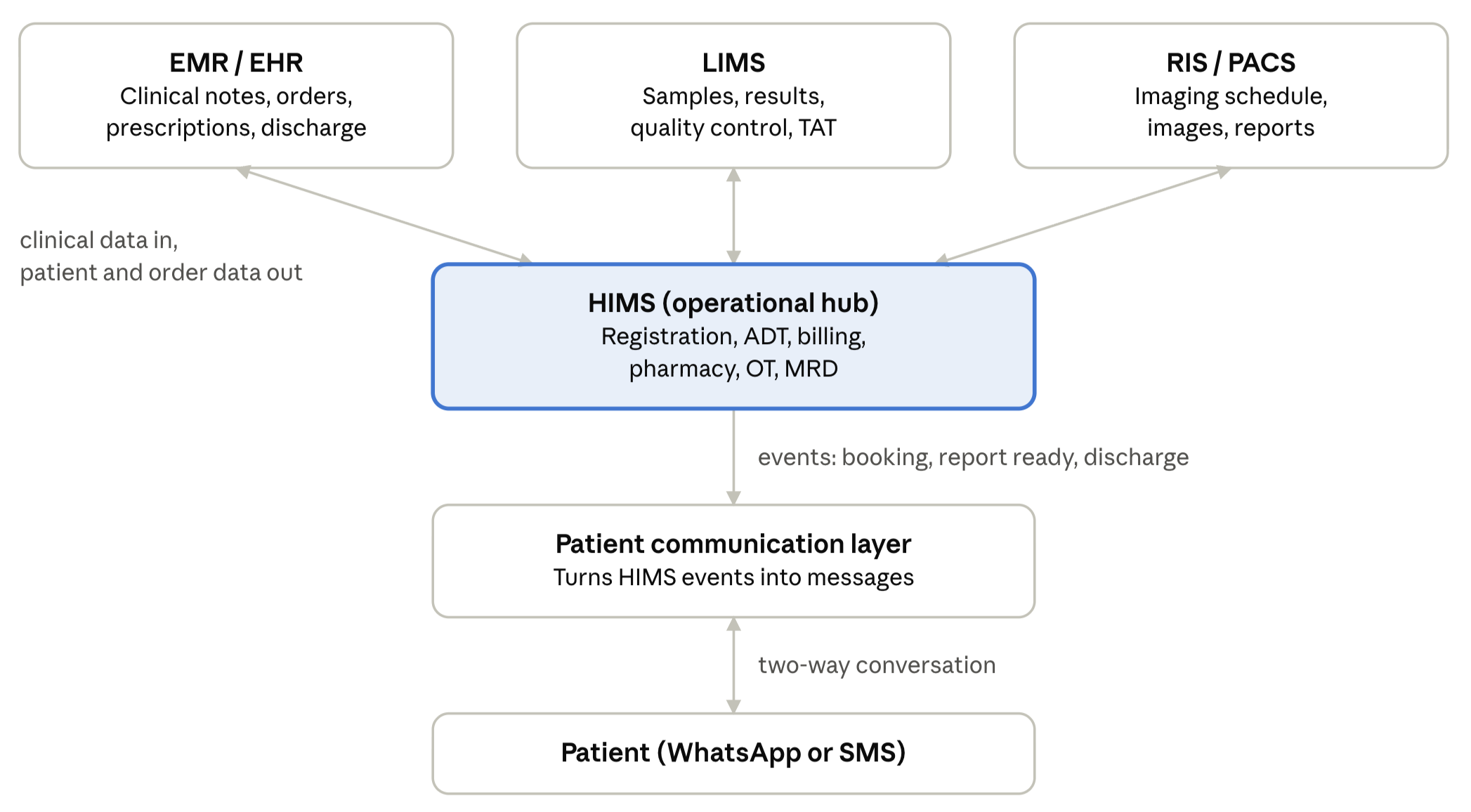
Clinical systems exchange data with the HIMS; a patient communication layer sits on top, turning HIMS events into conversations with the patient.