
Working with Hospitals: Metrics, Decisions, and Patient Experience
Bed metrics: occupancy, ALOS, bed turnover, ARPOB
Occupancy rate is the percentage of beds filled at a given time and is a core efficiency metric, because empty beds are lost revenue. Average Length of Stay (ALOS) is the average number of days a patient stays per admission; lower is generally more efficient, but a normal ALOS depends on case mix, so a cardiac ICU and a maternity ward differ widely. Bed turnover ratio counts how many patients pass through one bed in a period and multiplies revenue capacity without adding beds. Average Revenue Per Occupied Bed (ARPOB) is revenue per occupied bed per day and is the headline profitability metric corporate chains report to investors each quarter.
Patient and quality metrics: no-shows, NPS, readmissions
No-show rate is the percentage of booked appointments a patient misses; it is direct, provable revenue loss and the metric a patient-communication platform can most naturally improve. Net Promoter Score (NPS) and Customer Satisfaction (CSAT) measure patient satisfaction and willingness to recommend, and are increasingly tied to NABH standards and brand reputation. Readmission rate is the percentage of discharged patients readmitted within a set window, often 30 days, and is a quality signal watched increasingly by insurers and regulators.
Payer mix
Payer mix is the share of hospital revenue from cash, private insurance, and government schemes such as PM-JAY. It shapes a hospital’s financial risk profile and the complexity of its billing.
Matching metrics to stakeholders
When a hospital conversation turns to return on investment, the pitch should be expressed in the metric that stakeholder already owns. A CEO responds to ARPOB and occupancy, a Patient Experience Head to NPS and no-show rate, and a CFO to payer mix and readmission-related costs. The product is the same, but the number changes with who is in the room.
Executive, IT, and clinical roles
The CEO or Medical Superintendent evaluates a purchase for overall strategic fit and reputational risk and pays little attention to feature detail. The CIO or IT Head evaluates integration effort, data security, API quality, and uptime, but not clinical workflow nuance. The Medical Director and HODs evaluate clinical safety, workflow disruption, and credibility with peers, and care little about pricing structure.
Nursing, finance, and quality roles
The Nursing Superintendent evaluates the impact on nursing workload and the training burden, not billing or revenue. The CFO or Administrator evaluates total cost of ownership, ROI, and fit with the budget cycle, not technical architecture. The MRD and Quality Cell evaluate the effect on NABH and NABL compliance and audit trails and are unmoved by sales pitches or brand stories.
Marketing and procurement roles
Marketing and PRO evaluate patient-experience impact and brand differentiation, not backend infrastructure. Procurement evaluates vendor credibility, contract terms, and references, not product vision.
The most common mistake in selling to hospitals
The most common vendor mistake is pitching one member of the buying committee as if that person were the whole committee. Hospitals, in turn, often assume vendors do not understand how their decisions are made, so a vendor who clearly understands the decision map gains credibility in any serious evaluation.
The patient journey across the care continuum
A patient’s journey often spans months or years, not one visit. It usually starts with preventive care, such as health check-ups and screening camps, which is often where GP referral networks first bring a patient to a hospital. It continues to the OPD, the first real contact with a specific doctor for consultation, diagnosis, and possibly lab or radiology orders, and, if the patient is admitted, to IPD treatment and surgery coordinated across nursing, pharmacy, and diagnostics.
The journey then moves to discharge, with instructions, medication, and follow-up booking, which determines much of the readmission risk. It ends at home with chronic-care management such as medication adherence and follow-up visits, which for chronic conditions can last for years.
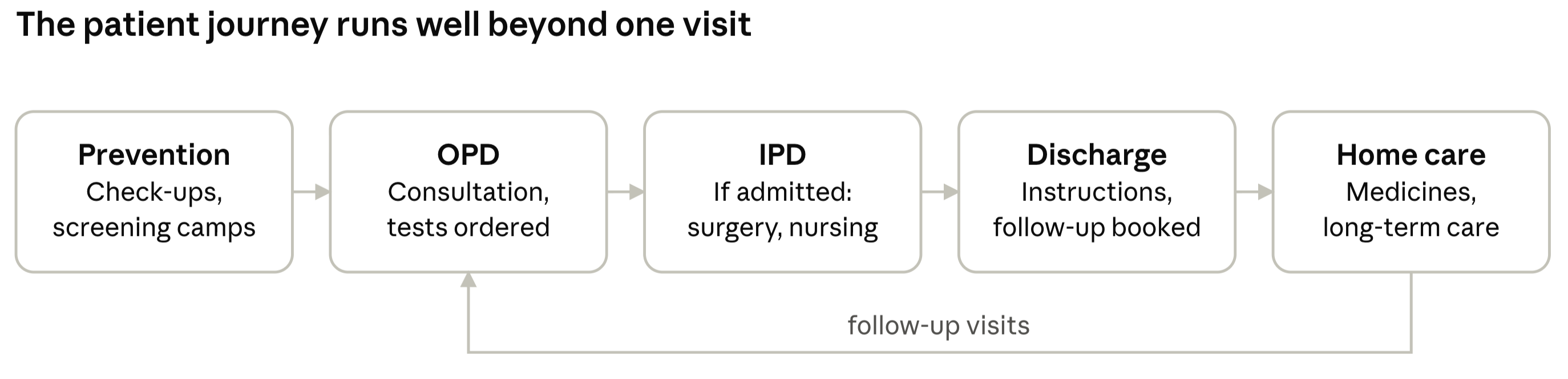
For chronic conditions the journey loops from home care back to the OPD for years, and every stage is a moment to communicate with the patient.
The gap between hospital systems and the patient conversation
HIMS, EMR, LIS, and RIS/PACS each manage one part of the patient journey well, but none is designed to manage the thread connecting those parts from the patient’s point of view. These systems were built to manage information such as records, orders, results, and billing, not the conversation with the patient. Because HIMS vendors built for clinical and operational workflow first, patient communication was added later as a basic SMS module that is one-way, limited in templates, and disconnected from the rest of the software stack.
The conversational layer opportunity
A patient-communication platform such as Conversive fills this gap as a conversational layer on top of the hospital’s record-keeping systems rather than a replacement for them. It turns HIMS events, such as an appointment booked, a report ready, or a discharge processed, into WhatsApp or SMS conversations with the patient. It also provides the analytics and compliance handling, including DLT, consent management, and the DPDP Act, that a basic SMS module was never built for.
Indian healthcare industry events
Many healthcare relationships and deals start at industry events where hospital leaders, doctors, and vendors meet. FICCI Heal, run by the Federation of Indian Chambers of Commerce and Industry, is one of India’s largest healthcare gatherings. NATHEALTH, the Healthcare Federation of India, represents hospitals, diagnostics, med-tech, and digital health companies, and CII Health is the Confederation of Indian Industry’s healthcare vertical with its own conferences and policy work.
Hospital Management Asia is a regional conference focused on hospital operations and administration. ET Healthworld runs the Economic Times’ healthcare event series, which the guide’s author’s team has found useful for partner relationships and warm introductions to decision-makers. At these events, attendees assume everyone understands the industry, so preparation is the difference between a wasted conversation and a real sales lead.
Terminology mistakes about doctors
Three terminology mistakes quickly cost credibility with hospital staff. “Ortho” means an orthopedic surgeon to a hospital administrator but an orthodontist to a dental clinic, so context must decide. An OB-GYN is one doctor covering both obstetrics and gynecology, not two specialists, and a Psychiatrist, a medical doctor who can prescribe, should never be confused with a Psychologist, who generally cannot.
Selling and process mistakes
Pitching “operational efficiency” without saying whether it means outpatient or inpatient operations shows inexperience, because the two are different problems with different metrics. Treating one enthusiastic champion as a done deal is another mistake, since hospital purchases pass separately through the clinical, nursing, and administrative arms. Not knowing which of the five ownership models a hospital follows, trust, corporate chain, single-owner, government, or PPP, leads to the wrong pitch, contacts, and timeline.
Referral and messaging-regulation mistakes
Treating “cut practice,” which is illegal under NMC rules, as the same as legitimate referral relationship-building is both a legal and a credibility risk. Forgetting that SMS and WhatsApp are regulated differently in India is a missed opportunity: SMS requires TRAI DLT registration and is silently blocked without it, while WhatsApp follows Meta’s own policy, which is one of the most concrete and provable talking points available.